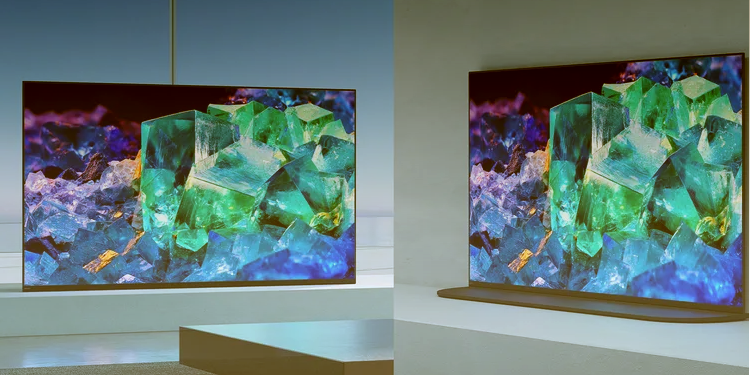
A research team from Nottingham Trent University in the UK, the Australian National University, and the University of New South Wales in Canberra have developed an experimental display technology that could replace the LCD panels used in many of today’s widescreen televisions.
How meta surface works.
While some modern high-end TVs may have quantum dot screens or OLED ( Organic Light Emitting Diode ) panels, many of the cheapest models available will use LCD (liquid crystal display) technology, polarizing filters, and LED ( Light Emitting Diode) backlights. But the researchers say the limit has been reached for the development of this type of technology. The team has developed electrically tunable arrays of nanoparticles called “metasurfaces” that may perform better and offer many advantages over LCD ( Liquid-Crystal Display) and LED (Light-emitting Diode) displays. For example, metasurfaces are 100 times thinner than liquid crystal cells, have “10 times” higher resolution, and consume 50 percent less power.
Which is the most important metrics of flat panel
“The most important metrics of flat panel displays are pixel size and resolution, weight, and power consumption. We have addressed each of these with our meta-display concept,” said lead researcher Mohsen Rahmani, a professor of engineering at Nottingham Trent University. The technology significantly reduces energy consumption
The researchers believe that the most significant benefit of their technology is the significant reduction in power consumption. “This is excellent news given the number of monitors and TV sets being used in households and businesses every single day. We believe it is time for LCD and LED displays to be phased out in the same way as former CRT ( Cathode Ray Tube) TVs over the past ten to 20 years,” said Rahmani.
The experimental platform uses a transparent conductive oxide
To drive individual pixels at a high modulation rate, the experimental platform uses a transparent conductive oxide that serves as an electrically driven heater that can rapidly change the optical properties of silicon metal surface cells, which are reported to be 100 times thinner. than liquid crystal cells or 200 times thinner than human hair. The technology provides sub-millisecond response times, 10 times faster than the detection limit of the human eye.
“Our pixels are made of silicon, which offers a long life span in contrast with organic materials required for other existing alternatives. Moreover, silicon is widely available, CMOS ( complementary metal oxide semiconductor) compatible with mature technology, and cheap to produce,” Professor Andrey Miro Shevchenko, a lead researcher in the Nanophotonics team at UNSW ( University of New South Wales ) Canberra, stated.
Does this use for dynamic virtual reality holography
This technology can also be used for dynamic virtual reality holography in LiDAR (Light Detection and Ranging) technologies and to produce thinner flat panels with 100 times higher resolution than current LCD-based displays, while cutting power consumption in half.
Furthermore, since a variety of metasurfaces can effectively replace the liquid crystal layer in modern displays, the researchers believe that manufacturers will not need to invest in new production lines to produce panels. The project will now focus on scaling the technology for big-screen TVs, as well as further improving the performance of metasurfaces using AI and machine learning.
Research summary:
In recent decades, metasurfaces have attracted a lot of attention due to their extraordinary light-scattering properties. However, its inherently static geometry is an obstacle for many applications where dynamic adjustment of its optical characteristics is required. Research is currently underway to dynamically tune the properties of the metasurface, especially with high tuning speed, large modulation by weak electrical signals, solid state, and the ability to program multiple pixels. Here we demonstrate electrically tunable metasurfaces controlled by the thermo-optic effect and flash heating on silicon.
How many changes in transmission at a bias voltage
We show a 9-fold change in transmission at a bias voltage of <5 V and a modulation rise time of <625 µs. Our device consists of a silicon hole array meta surface encapsulated with a transparent conductive oxide as a localized heater. This allows for optical switching of the video frame rate at various pixels that can be programmed electrically. Some of the advantages of the proposed tuning method over other methods are that it can be used for modulation in the visible and near-infrared, has great depth of modulation, operates in transmit mode, has a low optical loss, has low input voltage requirement, and it operates at a switching level. speed higher than video speed.
The device is also compatible with modern electronic display technologies and can be ideal for personal electronic devices such as flat panel displays, virtual reality holography, and light-sensing and ranging where fast, solid-state, and transparent optical switches are required.